

Hair loss in women is more than a cosmetic concern—it can deeply affect self-esteem, social confidence, and emotional well-being. While treatments like minoxidil and PRP therapy have gained popularity, regenerative medicine is now offering a new solution: exosomes for hair loss. These tiny biological messengers are showing impressive results in both clinical settings and scientific studies—and they may hold the key to reversing early-stage thinning and hormonal hair loss in women.
To learn more about other non-surgical solutions for hair loss in women click here.
What Are Exosomes?
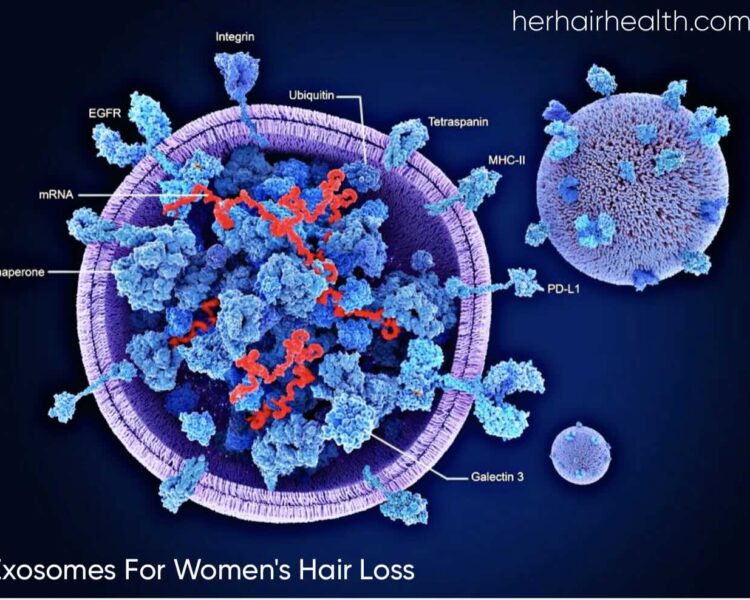
Exosomes are microscopic extracellular vesicles released by stem cells that carry proteins, growth factors, cytokines, and microRNA. Their role in the body is to promote cell-to-cell communication and signal tissue repair at the cellular level.
In the context of hair restoration, exosomes can:
- Stimulate dormant follicles
- Extend the anagen (growth) phase of the hair growth cycle
- Improve scalp environment by reducing inflammation
- Promote new blood vessel formation (angiogenesis)
Unlike live stem cells, exosomes are cell-free—making them safer, more predictable, and easier to administer. Among the emerging applications of exosomes, hair regrowth is one of the most promising.
How Exosome Therapy Supports Hair Regrowth
Emerging research has shown that exosomes can:
- Activate dermal papilla cells, which regulate hair follicle development and cycling (Schaffer et al., 2025)
- Increase blood flow to follicles, aiding oxygen and nutrient delivery through VEGF expression (Cheng et al., 2024)
- Reduce inflammation, a key driver in both androgenetic alopecia and autoimmune conditions
- Enhance follicular stem cell signaling through Wnt/β-catenin pathway activation (Ersan et al., 2024)
These cellular effects contribute to new hair growth in areas experiencing thinning and help prevent further miniaturization of hair follicles.
What the Research Shows
A growing body of clinical and preclinical data supports the regenerative potential of exosomes for hair loss in women.
- The AlviArmani Preclinical Study (2025) conducted by the AlviArmani Research Institute investigated the effects of two commercial exosome products on human hair follicle viability and gene expression using proprietary Microscalp Viability Assays and PCR-based analysis. Results demonstrated:
- Dose-dependent improvements in follicular viability
- Increased expression of genes associated with hair growth
- Greater efficacy in one product formulation, particularly in boosting expression of Gene 3, a critical marker for follicular regeneration
These laboratory findings offer compelling mechanistic evidence that exosomes can directly enhance follicular performance, supporting their clinical use in patients with androgenetic alopecia, telogen effluvium, and alopecia areata.
- The AlviArmani Literature Review compiles findings from over a dozen peer-reviewed sources, including randomized trials and in vivo studies, all supporting the ability of exosomes to regulate inflammation, promote angiogenesis, and activate dermal papilla cells.
This research aligns with publications in peer-reviewed journals such as Schaffer et al. (2025), Ersan et al. (2024), and Cheng et al. (2024)—all of which confirm that applications of exosomes in female hair restoration are grounded in strong scientific evidence.
Who Is a Good Candidate?
Exosome therapy may be ideal for women experiencing:
- Early to moderate female pattern baldness
- Telogen effluvium due to stress, illness, or postpartum changes
- Hormonal hair thinning during perimenopause or menopause
- Mild alopecia areata
- Thinning following a hair transplant procedure
It is not recommended for women with advanced balding or total follicular depletion (e.g., scarring alopecia), as active follicles are necessary for stimulation.
Exosomes vs PRP: What’s the Difference?
Many women ask: How does exosome therapy compare to PRP (Platelet-Rich Plasma)? Here’s a breakdown:
| Feature | PRP | Exosomes |
|---|---|---|
| Source | Your own blood | Donor-derived stem cells |
| Potency | Formulation Dependency (platelets only) | Formulation Dependency (miRNA + growth factors) |
| Consistency | Patient-dependent | Standardized, lab-prepared |
| Procedure | Requires blood draw, autologous | No blood draw |
| Ideal For | Mild thinning | Early-to-mid hair loss |
Some advanced clinics even combine both treatments for enhanced results.
Explore more about PRP therapy here.
Safety, Cost, and Considerations
Exosome therapy is considered safe when administered by experienced professionals in a clinical setting. The exosomes used in hair restoration are typically derived from umbilical cord or adipose-derived mesenchymal stem cells, rigorously screened for purity. As a cell-free product, they carry low risk of immune rejection or infection.
- Side effects: Mild redness or swelling at injection sites (temporary); minimal discomfort
- Cost per session: $2,500–$8,000
- Downtime: None; patients resume normal activity the same day
- Number of treatments: 1–3 spaced 4–6 weeks apart
- FDA status: Not yet FDA-approved specifically for hair loss; currently used off-label with physician guidance
Combining Exosomes with Other Hair Loss Solutions
A regenerative solution like exosomes works best when combined with a comprehensive plan tailored to your hair needs. This may include:
- Organic hair supplements
- Topical treatments like minoxidil
- Scalp massage or red light therapy
- Scalp micropigmentation (SMP) for visual density
- Hair transplants for women in cases where follicle loss is more advanced
Your provider can help you decide how exosomes fit into your long-term hair health journey.
Takeaway
Exosomes for hair loss are redefining what’s possible in female hair restoration. With promising clinical results, extensive academic support, and real-world success stories from leading clinics like AlviArmani, this treatment is quickly gaining traction among women seeking natural, non-surgical options with minimal downtime and high potential for new hair growth.
If you’re struggling with thinning, shedding, or early-stage alopecia, exosome therapy could be the breakthrough you’ve been waiting for. As always, your best results start with a personalized consultation and a holistic approach to treatment.
FAQs
1. Are exosomes better than PRP for women’s hair loss?
Exosomes anecdotally contain a higher and more consistent concentration of regenerative molecules than PRP. While no head to head studies have been performed to our knowledge, many women, especially those with hormonal or postpartum shedding, exosomes may lead to more dramatic and lasting results.
2. How soon will I see results?
Most women begin noticing reduced shedding within 3–4 weeks. Visible thickening and new hair growth typically occur between 3 and 6 months after treatment.
3. Are exosomes safe for autoimmune-related hair loss?
They may help in mild cases of alopecia areata by reducing inflammation, but more research is needed for scarring alopecia. Always consult with a provider who understands autoimmune hair loss. This is particularly important as more FDA approved options are becoming available to manage alopecia areata.
4. How many treatments do I need?
Most patients see improvement after just 1–2 sessions, but some may need 3 for optimal density. The more important consideration is finding a consistent routine over time.
5. Can exosomes regrow hair on completely bald patches?
Exosomes require partially active follicles to stimulate growth. They’re best for thinning areas—not for fully bald or scarred regions.
Citations
- Schaffer S, Tehrani L, Koechle B, Chandramohan P, Hilburn B, Aoki KC, Jacobs RJ. A Scoping Review of Exosome Delivery Applications in Hair Loss. Cureus. 2025 Mar 25;17(3):e81152. doi: 10.7759/cureus.81152. PMCID: PMC12020662
- Ersan M, Ozer E, Akin O, Tasli PN, Sahin F. Effectiveness of Exosome Treatment in Androgenetic Alopecia: Outcomes of a Prospective Study. Aesthetic Plast Surg. 2024 Nov;48(21):4262-4271. doi: 10.1007/s00266-024-04332-3. PMCID: PMC11588828
- Cheng M, Ma C, Chen HD, Wu Y, Xu XG. The Roles of Exosomes in Regulating Hair Follicle Growth. Clin Cosmet Investig Dermatol. 2024 Jul 5;17:1603-1612. doi: 10.2147/CCID.S465963. PMCID: PMC11232880
- AlviArmani. Exosome Therapy Hair Loss Study – Clinical Outcomes. Accessed July 2025.
- AlviArmani. Exosomes in Hair Loss – Literature Review. Accessed July 2025.
- Hayatdavoudi AB, Seneviratne C, Barton C, Ischayek M, Hayatdavoudi B. Evaluation of Exosomes for Hair Loss: A Primary Preclinical Study Comparing Efficacy. AlviArmani Research Institute. May 2025. Accessed July 2025.