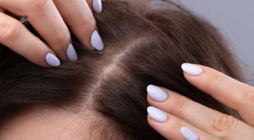



Shedding too much hair? What is shedding and how is it different from hair loss? Let’s find out:
The Hair Cycle
The typical head contains about 100,000 hair follicles.[1] Each follicle progresses through a four-stage growth cycle 10-30 times a lifetime. The cycle is a continuous process and involves the phases: anagen (growth phase), catagen (regression phase), telogen (rest phase), and exogen (shedding phase).[1]
Anagen, the longest phase, is where the follicle develops and can last anywhere from 2-8 years. More than 85% of the hairs on the scalp reside in the anagen phase in a healthy individual.[2] Catagen is a short-lasting phase, two weeks, where the follicle prepares for telogen/rest phase. At any given time about 10% of the hairs on a healthy human head are in the telogen/rest phase. This amounts to a ratio of 14 hairs in growth for every 1 hair in rest.[1]
Telogen generally lasts 2-3 months during which new hairs begin to form at the base of the old hair. This leads to the final stage, exogen, during which the old hair is pushed out by the new hair or “sheds out”.
Normal exogen shedding occurs at a rate of about 100 to 150 hairs per day.[1] These are the hairs you see on the pillow when you wake up and it is completely normal.
What If I Shed More Than 150 Hairs on My Pillow Per Day? What is Excess Shedding?
The anagen to telogen ratio can be influenced towards growth or rest depending on the trigger. Telogen effluvium is a self-limited condition involving a trigger which leads to a greater proportion of hair follicles in telogen phase.[1] This in turn leads to excess shedding. During the active phase of telogen effluvium suffering patients may have a ratio of 8 anagen follicles for every 1 telogen, a significant difference from the 14:1 ratio in a healthy scalp.
| Growing, (Anagen), Follicles | Resting, (Anagen), Follicles | |
| Normal | 14 | 1 |
| Telogen, Effluvium | 8 | 1 |
| Androgenetic, Alopecia | 5 | 1 |
| Alopecia, Areata | 5 | 5 |
Aging is another process that changes the ratio of anagen follicles to telogen follicles. During aging anagen cycles become progressively shorter, thereby increasing the proportion of hairs in telogen. This is the process of androgenetic alopecia or male and female patterned hair loss. Ratios from male and female pattern balding can reach 5 anagen follicles for every 1 telogen follicle.[1]
What Can Lead to Accelerated Hair Shedding?
Research has shown a number of triggers can lead to a smaller anagen to telogen ratio, consistent with concerns for accelerated shedding. Amongst possible causes are inflammation, hormonal variations, stress, nutritional deficiencies, medications and lack of sleep. All of these potential mechanisms may work by promoting anagen to telogen transition or by telogen effluvium depending on the circumstances. For instance, protein malnutrition in a vegetarian may lead to a gradual decrease in anagen to telogen ratio while sudden weight loss through a crash diet may cause telogen effluvium. Telogen effluvium will present with sudden and diffuse hair shedding.
In Conclusion
Hair follicles cycle through four different stages. Hair shedding is a natural part of that cycle and occurs at a rate of 100-150 hairs per day. The ratio of the number of follicles in the growth phase to the rest phase can be measured to assess the degree of hair shedding. Telogen effluvium and androgenetic alopecia can both lead to a decrease in the growth to rest ratio, indicating accelerated shedding. Further, certain triggers may lead to increased shedding through various mechanisms.
Sources
- Natarelli et al. Integrative and Mechanistic Approach to the Hair Growth Cycle and Hair Loss. 2023. 12(3):893
- Bergfeld W. Shedding: How to manage a common cause of hair loss. Cleveland Clinic Journal of Medicine. 2001. 68(3)