

Many women reach clarity about their hair long before they take action.
They may already know they want:
- a more defined or restored hairline
- improved density at the part or temples
- relief from constant styling, camouflage, or worry
- eyebrows that reflect how they used to look
Yet despite this clarity, months or even years often pass before a permanent decision is made.
This delay is rarely about confusion. More often, it reflects how women are conditioned to approach irreversible aesthetic decisions—with caution, privacy, and a high threshold for “permission.”
Many women decide long before they act
In consultations, it’s common to hear variations of:
“I’ve been thinking about this for a long time.”
Often, women have already researched modern options and understand that FUE hair transplant procedures can be adapted for female hair patterns, discretion, and natural hairline design. Many arrive having read about candidacy and timing, such as in discussions around whether FUE is appropriate for women and when it tends to be most effective.
Despite this knowledge, hesitation remains—not because the option is unclear, but because the decision feels consequential in a way that extends beyond hair.
1. Wanting change is often treated as something that needs justification
Women are frequently taught—implicitly or explicitly—that aesthetic decisions should be defended.
Instead of simply wanting improvement, many feel pressure to wait until the problem is “bad enough,” medically framed, or externally validated. This mindset can delay action even when quality of life is already being affected.
As outlined in Hair Transplants for Women, hair restoration is not about reaching a crisis point. It’s about addressing a concern that is stable, persistent, and meaningful to the individual.
Reducing daily stress, mental bandwidth, or emotional burden is a legitimate reason to consider a permanent solution.
2. Privacy concerns often outweigh procedural concerns
For many women, the hesitation is not fear of surgery—it’s fear of visibility.
Common concerns include:
- temporary redness or shedding
- navigating work or social settings during healing
- unwanted questions
- appearing “obvious”
This is why women often spend significant time reviewing details around discretion, recovery, and staging before committing. Many of these practical questions are addressed in resources like the FUE Hair Transplant for Women FAQ, which covers healing timelines, concealment strategies, and expectations in detail.
Privacy is not avoidance. It is a value—and one that should be incorporated into planning.
3. Many women wait for a “permission moment” that never comes
Hair loss in women tends to progress gradually, without a clear inflection point.
This leads many women to wait for:
- more thinning
- a major life transition
- reassurance that action is “reasonable”
But waiting for urgency can limit options. Women exploring female hairline restoration with FUE often find that earlier intervention—once hair loss is stable—offers more design flexibility and more natural-looking outcomes, particularly at the hairline.
A more helpful question than “Is it bad enough?” is often:
“Am I tired of managing this every day?”
4. Permanent decisions feel risky without adequate support
Women are more likely to delay when consultations feel rushed, overly technical, or narrowly focused on one solution.
Supportive evaluation includes:
- identifying the cause and stability of hair loss
- discussing both surgical and non-surgical options
- outlining realistic timelines and tradeoffs
- acknowledging emotional, logistical, and privacy concerns
A comprehensive approach—like the one outlined across the Hair Transplants for Women pillar—helps women feel informed rather than pressured, which often shortens the decision timeline.
5. The healing phase is emotionally challenging—and women anticipate it
Even when outcomes are excellent, early recovery after hair restoration can involve:
- temporary shedding
- redness or texture changes
- uneven appearance during early growth
Women are often acutely aware of these phases and may delay to avoid the temporary disruption.
However, while recovery is finite, the daily effort required to manage thinning hair—styling adjustments, concealment, constant monitoring—can persist indefinitely. For many women, addressing the issue thoughtfully but earlier reduces long-term stress.
6. Hair restoration decisions are not binary
Another reason women delay is the belief that the decision is all-or-nothing.
In reality, hair restoration exists on a spectrum.
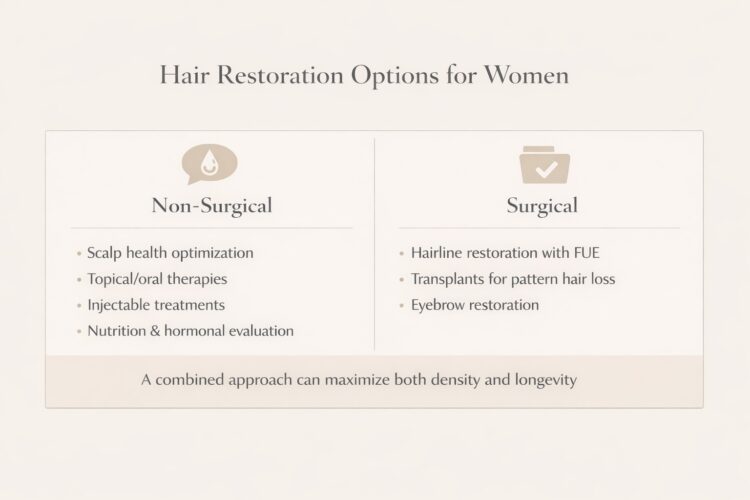
Non-surgical approaches may include:
- scalp and follicle health optimization
- nutritional or hormonal evaluation when appropriate
- topical or oral therapies
- injectables for hair growth in selected cases
Surgical options may include:
- female hair transplant for stable pattern thinning or traction-related loss
- targeted hairline refinement using FUE
- eyebrow restoration for long-standing thinning or loss
Combined strategies often work best:
- restoring structure surgically where needed
- supporting remaining follicles medically to preserve future density
Understanding this range—clearly mapped across the Hair Transplants for Women pillar and its supporting articles—often restores a sense of control and reduces fear.
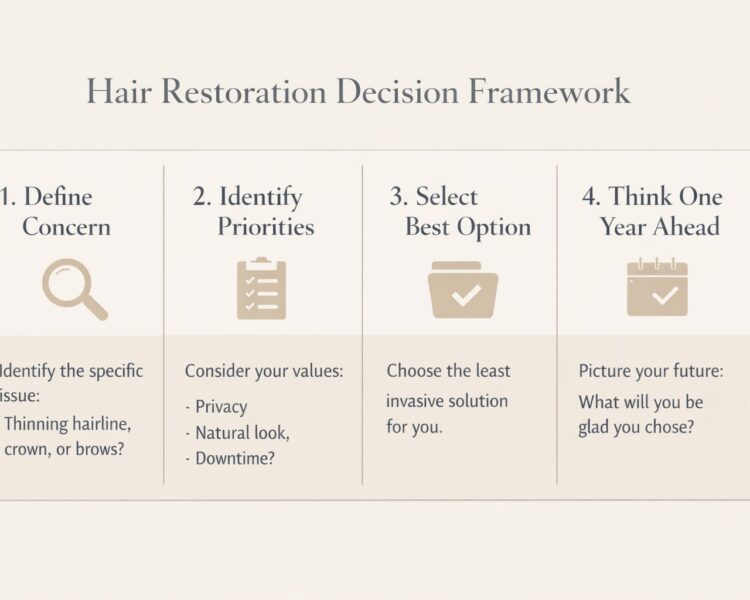
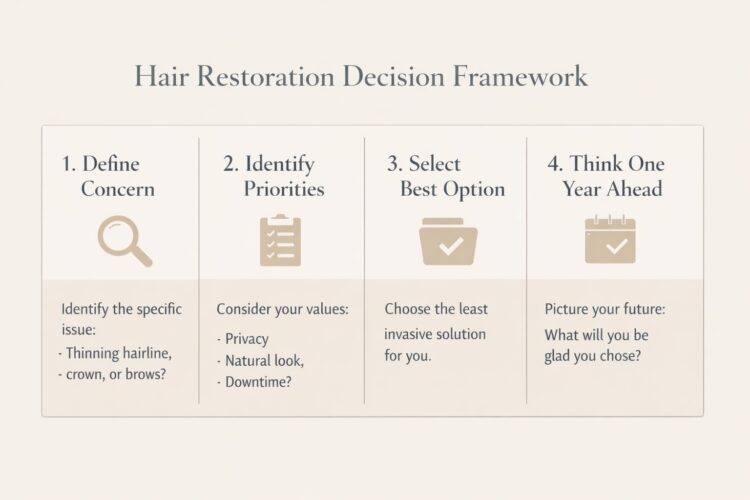
A practical decision framework
If you feel stuck, the following steps can help clarify the path forward:
1. Define the specific concern
Examples include:
- widening part
- receding or uneven hairline
- crown visibility
- eyebrow density
- daily styling fatigue
2. Identify your priorities
Common values include:
- privacy
- natural appearance
- minimal downtime
- long-term predictability
3. Choose the least invasive option that truly solves the issue
Not the smallest intervention overall—but the one that addresses your goal.
4. Think one year ahead
Which decision would you feel relieved you made?
Beauty decisions as personal agency
For many women, hair is not about vanity—it’s about ease, confidence, and not spending mental energy managing appearance every day.
Some cultural perspectives frame beauty decisions as acts of personal agency: choosing what you will manage and what you will no longer manage. Writers such as Yazamin explore this idea through the lens of intentional beauty and personal authorship.
You can read more on that perspective here:
https://yazamin.io
Delaying does not mean you are behind
Delaying a permanent decision is often thoughtful, not avoidant.
The goal is simply to ensure the delay is serving you—not prolonging unnecessary stress.
A constructive next step may include:
- an educational consultation
- medical evaluation if shedding is active
- discussion of staged or hybrid approaches
- planning for privacy and recovery timing
Clarity often makes the decision feel lighter.